
Every space program reaches the same awkward moment in early study. The operational concept lives in one set of slides, the system architecture in another, and the mass, power and link budgets in a spreadsheet that nobody quite trusts. Each is internally coherent; none of them agree. The Unified Architecture Framework exists to close that gap, not by adding more diagrams, but by giving the whole analysis a shared coordinate system.
01A framework, not a diagram set
It is tempting to treat UAF as "DoDAF with a SysML profile" and leave it there. That framing misses the point. What UAF actually provides is a structured question set: for any system of interest, it asks you to describe the same handful of concerns (taxonomy, structure, connectivity, behaviour, states and constraints) across several domains, from the operational world down to the physical resources that realise it.
For a space mission that discipline is unusually valuable. A satellite program spans organisations, ground and flight segments, contractual interfaces and a long operational life. The framework forces each of those to be expressed once, in one model, and then related, so a change to the downlink concept can be traced all the way to the antenna sizing without anyone re-typing it into a new artifact.
UAF doesn't make the model smaller. It makes the relationships between its parts impossible to lose.working note, mission Phase A review
02The grid: viewpoints as coordinates
The most useful mental model is a grid. Columns are domains (Operational, Resources, Services, Personnel) and rows are aspects, Taxonomy, Structure, Connectivity, Processes, States, Constraints. Each cell is a viewpoint: a defined view answering one question about one domain. You don't fill in all of them. You populate the cells the mission actually needs and leave the rest empty, and that emptiness is itself information, it says "we made no claim here yet."
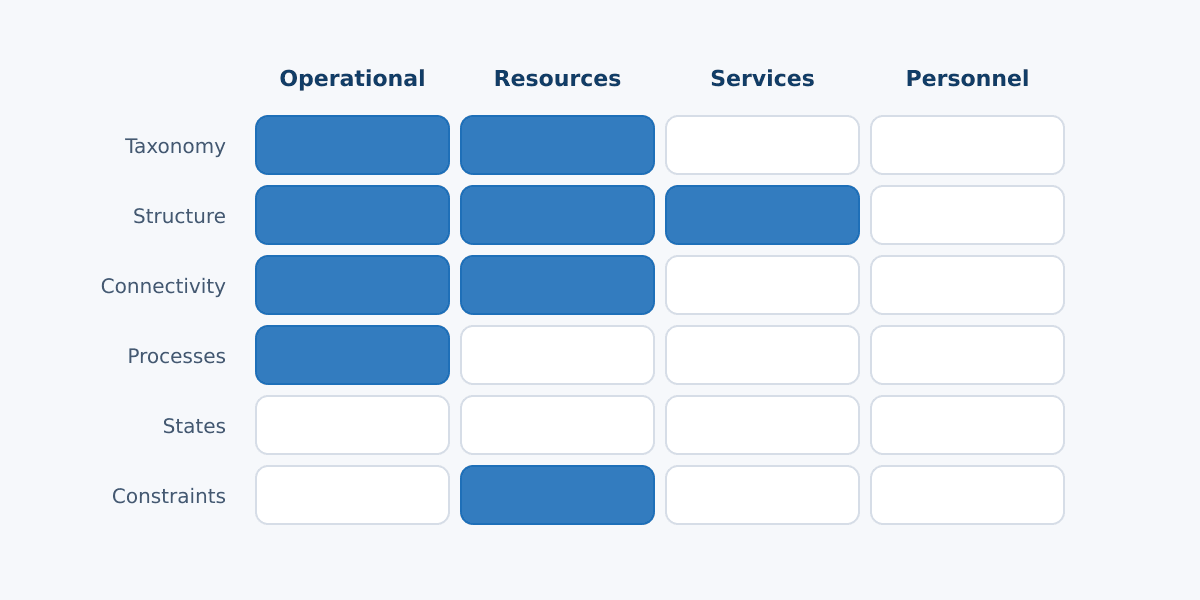
In practice we worked left-to-right and top-to-bottom only loosely. The operational taxonomy and connectivity came first because the customer's needs were framed operationally. Resource structure followed, then constraints, where the budgets finally entered the model as real, traceable parameters rather than spreadsheet cells.
03From operational concept to architecture
The operational viewpoints are where UAF earns its keep on a space study. Before any box is drawn in the architecture, you describe the mission as a set of operational nodes exchanging information to achieve a capability. A ground station tasks mission control; mission control commands the spacecraft; the payload returns science data. None of that names a subsystem, it is deliberately solution-free.
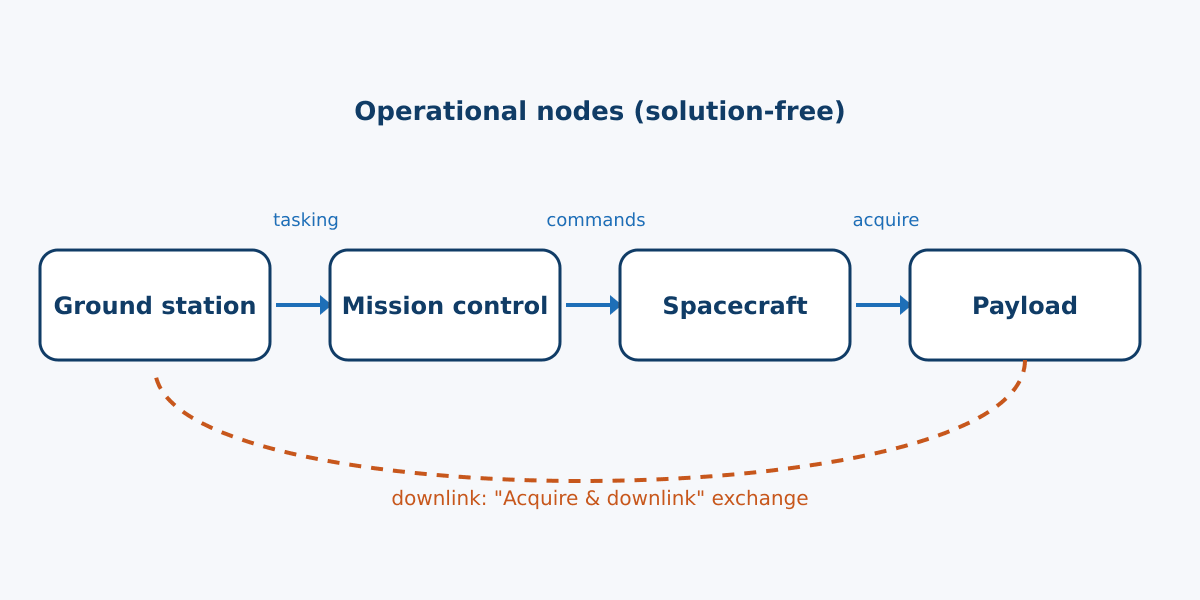
The payoff comes at the next step. UAF defines explicit mappings from the operational world to the resource world: operational nodes are realised by resource roles, operational exchanges are carried by resource interfaces. When the customer changes the concept (say, adding an onboard autonomy mode) the affected resources light up automatically, because the relationship was modelled, not narrated.
What this replaces
- The "concept of operations" deck becomes a queryable model, not 60 slides nobody re-opens.
- The interface matrix is derived from the connectivity viewpoint rather than maintained by hand.
- Traceability to need is a model relationship, so coverage gaps are a query result, not an audit.
04Allocating functions to resources
Once the operational architecture is stable, functions are allocated to the resource architecture, the physical and logical building blocks of the flight and ground segments. This is where a space mission's budgets stop being a separate document. Mass, power and data-rate are captured as constraint properties on the resources and rolled up through the structure.
// Power budget rolled up across the resource structure
block SpacecraftBus {
  value powerBudget : W = 820.0;
  part payload   : Payload;     // draws 310 W peak
  part adcs      : ADCS;        // draws  95 W
  part comms     : XBandTx;     // draws 140 W on downlink
  constraint margin { sum(parts.draw) <= 0.7 * powerBudget }
}
Because the constraint lives in the model, the analysis tool can flag the violation the moment the payload's peak draw is revised, long before it reaches a formal budget review. That is the whole argument for MBSE compressed into one screen: the budget and the architecture are the same artifact, so they cannot drift.
05Where SysML still does the work
UAF organises; SysML executes. The framework tells you which views to build and how they relate, but the underlying language is still SysML, and the detailed behaviour (activity flows, state machines, parametric constraints) is pure SysML modelling underneath the UAF stereotypes. On this study we dropped to plain SysML internal block diagrams whenever the conversation turned to a specific interface, and let UAF re-frame the result at the architecture level afterward.
The lesson is to keep both tools in hand. Use UAF for the structure of the analysis and for the traceability the customer and the standards body will ask about. Use SysML, and where the physics demands it co-simulation through FMI, for everything that has to actually run.
06What we'd do differently
Two things. First, we under-invested early in the taxonomy, the dictionary of terms the whole model leans on. A loose taxonomy meant two engineers modelled "ground segment" slightly differently, and reconciling that late cost more than defining it up front would have. Second, we treated the framework as more rigid than it is. UAF is meant to be tailored; the half-dozen viewpoints we actually needed could have been agreed in the first week instead of discovered over a month.
None of this is unique to space. But a mission study is an honest stress test for any architecture framework: long lifecycles, hard physical budgets, many organisations, and no tolerance for the operational concept and the engineering quietly disagreeing. UAF held up, provided you remember it is a way of asking questions, not a stack of diagrams to fill in.